When Culture Becomes Infrastructure
Performing arts centers are often described by what happens inside them, but their deeper influence lies beyond the building, in the life they help shape around it.
There is a version of civic architecture that announces itself. It sits apart from the city, monumental and complete, asking to be admired. And then there is another kind, the building that works quietly, over years, reshaping what surrounds it.
The performing arts center, when designed with intention, belongs to the second category. Its real work is not done in the concert hall or the rehearsal room. It's the neighborhood that forms around it, the university that becomes more itself because of it, the city that finally has a reason to gather.
It's a conviction that has shaped our approach to performing arts work for decades, and one that three completed projects put to the test.

When Christopher Newport University broke ground on the Ferguson Center for the Arts, the site presented an obvious challenge. The building was going up on the former footprint of Homer L. Ferguson High School, hemmed in by existing campus development, nearby cultural institutions, and multiple constituencies.
Rather than treating these conditions as limitations, the design team approached them as an opportunity to build connection. The resulting building became the anchor of what has since grown into a recognizable arts corridor linking Christopher Newport to The Mariners' Museum and the Peninsula Fine Arts Center. Its most lasting contribution was perhaps spatial and civic. It gave structure to a cultural landscape that hadn't previously had one.
"This is one of the more exciting things to happen in Newport News in a generation. It signals the transformation of the community as well as the university and the region. It is a world-class facility..."
– Newport News Mayor Joe Frank

The numbers that followed were striking. In its first seven years, the Ferguson Center drew more than 80,000 visitors annually, generated an estimated $1.5 million in local restaurant revenue, and logged roughly 5,600 hotel room nights per year. The center reached financial self-sufficiency within its first several years, a threshold that many comparable venues never reach.
Inside the university, the building took on a different kind of significance. It became the third leg of what administrators call the "CNU triumvirate," joining the Freeman Center for athletics and Trible Library for academics, with Ferguson representing what one might call the soul of the institution.
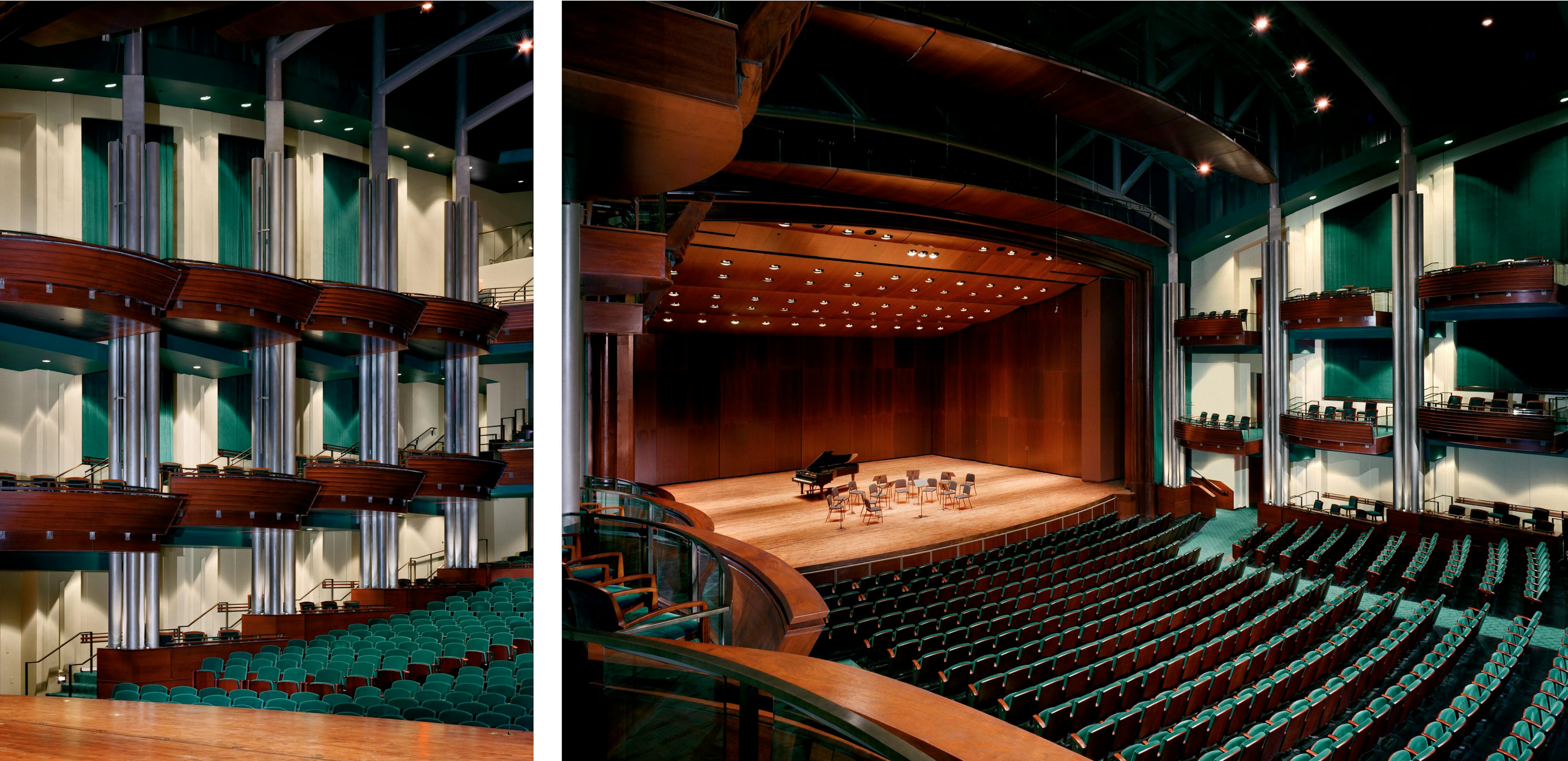
For many students and families, it is the building that makes the first impression. Nearly three million people have walked through its doors since opening. The 1,725-seat Diamonstein Concert Hall is routinely cited among the finest acoustic spaces in the region.
The Forbes Center for the Performing Arts at James Madison University opened in 2010 on the edge of a relatively quiet downtown Harrisonburg. What followed became something of a case study.
Between 2007, when the project was in development, and 2013, the number of residential units in downtown Harrisonburg grew from 150 to more than 550. New restaurants opened. Cultural programming expanded. The downtown that had once been largely dormant after business hours began developing the texture of a place where people actually wanted to be.
Correlation is not causation, and downtown Harrisonburg's growth reflects a range of factors. The Forbes Center's role as a catalyst, however, is difficult to dismiss.
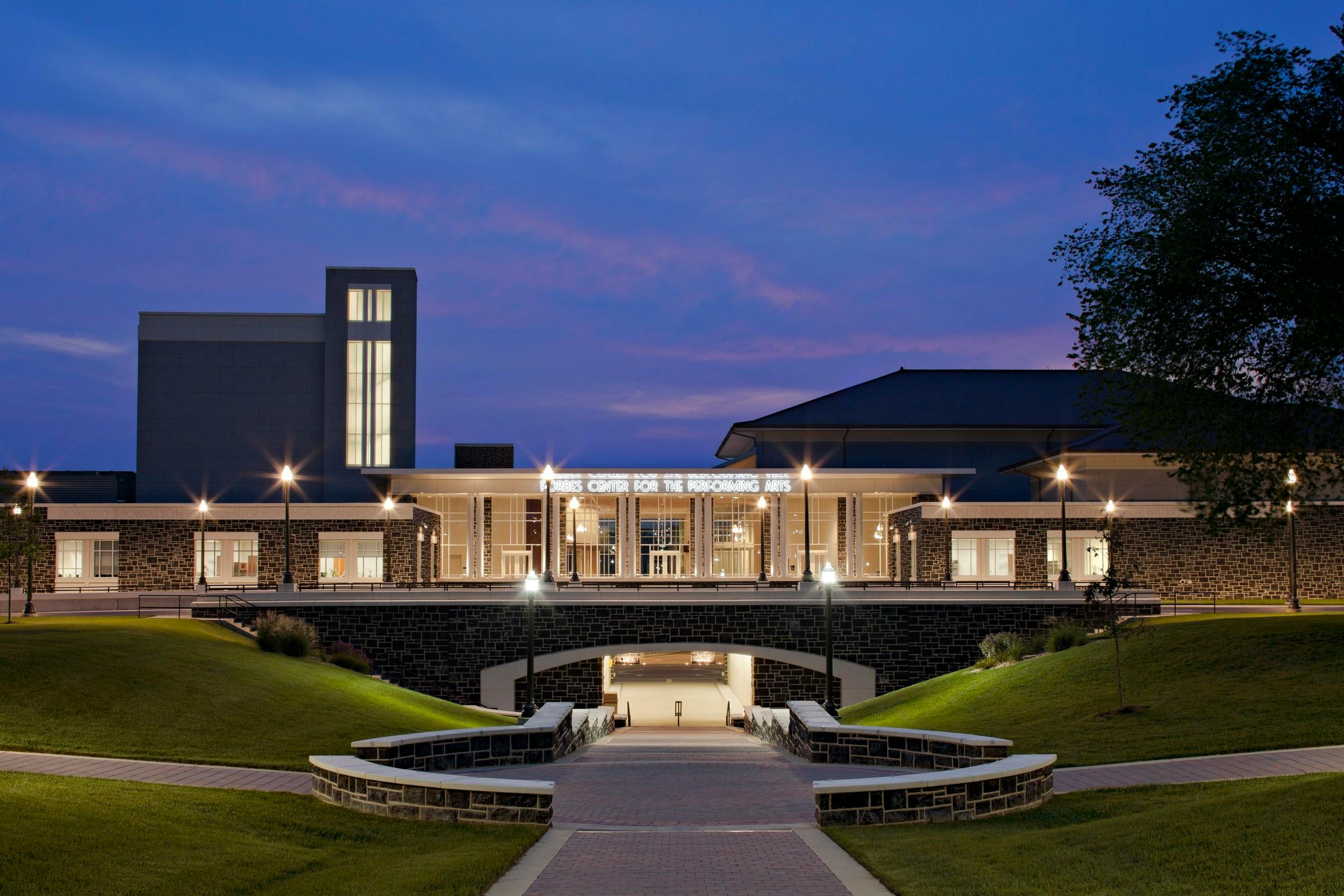
In the decade after opening, the center hosted more than 2,900 performances and drew over 400,000 patrons. It currently reaches more than 43,000 audience members in a typical season, including livestreamed performances that extend its reach beyond the Shenandoah Valley.
Its academic impact has been equally significant. In the years following the building's opening, James Madison University introduced a Doctor of Music degree. The venue's five performance spaces, including a proscenium theater with a custom tension-wire grid, give students environments that reflect professional expectations while supporting experimentation and collaboration.

For institutions considering a performing arts center, the harder work is understanding what the building does beyond performance, like how it serves students outside the hall, and how it welcomes the public. Those are the things that determine whether a performing arts center becomes infrastructure or simply a very expensive room.
In Virginia Beach, the design team behind The Dome at Atlantic Park was grappling with a problem that is, at its core, about time. A venue that seats 3,500 people is only full on certain nights. What does it offer the city on a Tuesday afternoon when nothing is scheduled?
The answer was to design for the in-between, to make the building permeable enough, and the surrounding site generous enough, that the space has a life independent of its programming calendar.
With six oversized hangar doors opening the venue fully to the surrounding streetscape, the threshold between building and city effectively disappears. On event nights the terraces become amphitheater seating; when the venue is dark, they revert to something simpler and equally valuable, public space that remains programmable and available to the community.


“We thought about it as the extraverted version of the original Dome. The surrounding buildings are sculpted to form the walls of this outdoor room, capturing its imprint. It carries the same energy, but instead of being contained, it spills outward into a space people can move through and experience together."
– Alec Yuzhbabenko, Design Director
The Dome sits within Atlantic Park, a 10.95-acre development designed to stitch together two parts of the city, the Virginia Beach Oceanfront and the neighboring ViBe Creative District, that had long operated in isolation of each other.
A venue of this scale could have closed off the block. Instead, it works as a threshold that draws people across the site and concentrates activity between the two districts. Since opening in May 2025, The Dome has welcomed more than 30 national acts, is projected to host roughly 100 events each year, and has even held its first wedding.
Designed in collaboration with Gensler and Cooper Carry, The Dome carries the weight of a site with genuine emotional resonance for the city. The original geodesic Dome was, for many Virginia Beach residents, the defining image of the city's mid-century identity. What the new building inherits from its predecessor is its purpose: to be the place where the city gathers.


There is a version of this story that sits comfortably within the realm of architecture and urban planning, full of design decisions, economic metrics, and the optimal placement of a loading dock. But the more interesting version is about what these buildings allow an institution and its community to become.
Performing arts centers, when they work, do something very few building types can claim. They create the conditions for shared experience. Not the passive kind found in a shopping mall or an airport, where people occupy the same space without particularly acknowledging each other, but the active kind, where people gather with shared purpose. The kind that helps define not just an arts program, but a relationship between a campus and the life around it.

That experience has economic consequences. It influences institutional identity, recruitment of students and faculty, and the willingness of developers to bet on a neighborhood. But its most durable returns don't show up in impact studies. They are the slow, cumulative effect of a city that has a place to gather, a building that tells residents something about what they value.
These are the questions we return to at the start of every performing arts project. Not just how the building performs, but what it sets in motion. Over time, the most successful performing arts centers become not just buildings for culture, but part of the infrastructure that sustains it.