Twelve Years in the Triangle
Longtime Raleigh colleagues reflect on twelve years of growth in North Carolina and how the work helped transform Hanbury's architectural practice.
In 2018, three people working upstairs in a small historic house on Boylan Street were charged with building Hanbury's Raleigh practice. The firm had established a presence in North Carolina four years earlier, but a new investment in design talent signaled larger ambitions for Raleigh and its role within Hanbury.
One of the team's first assignments was the APEX Student Success Center at William Peace University. Working within a limited budget, the team transformed an existing library into a series of multipurpose spaces that could accommodate different activities throughout the day.
“We made a Swiss Army knife out of the main library,” recalls Jesse Green, Hanbury's Design Director. For Green, the project reflected an approach that would guide the growing practice. “No opportunity is taken for granted.”


Eight years later, the Raleigh studio has grown to more than 50 professionals. Its portfolio includes Novo Nordisk's 1.4-million-square-foot pharmaceutical manufacturing expansion in Clayton, North Carolina, a project that illustrates how dramatically the scale and complexity of the practice's work have changed.
Hanbury had spent decades designing for higher education, and North Carolina's concentration of universities and biotechnology companies offered an opportunity to build on that experience. Developing a science practice would broaden the firm's expertise beyond its established markets.

“It was a very intentional strategy of Hanbury to diversify,” said Chris Small, Science Market Leader, who joined the team in 2019. “It was all about starting a science practice and kind of creating that balance of markets.”
The harder part was convincing prospective clients to trust a practice with little completed local work. “We had a slide deck with nothing but renderings of projects we'd started,” Small recalled. “There was no built work to show.”
The early team pursued studies and smaller projects, relying on the experience and relationships people brought with them to gain clients' trust. “We focused on relationships, relationships and talent,” said Lauren Eaton, Laboratory Planner and longtime member of the Raleigh team. “That is what built the foundation of our office.”

Early projects with Syngenta and VGXI helped establish the science practice, creating opportunities to recruit talent across disciplines. As the team grew, so did the range of expertise available in Raleigh and the complexity of work it could undertake.
The ambition, Green recalled, was never limited to building a regional practice. “Raleigh was never considered a satellite office,” he said. “Individuals in Raleigh filled firmwide leadership roles right from the start.”

As Raleigh expanded, colleagues took on responsibilities that hadn't previously existed within the firm. “There wasn't a playbook we could just follow,” Small said. “It was about figuring things out and trying to leave it better than you found it each day.”
Eaton remembers when laboratory planning relied on just a few people. “I never imagined having an actual lab planning team.” Today, that dedicated team supports projects across Hanbury. Raleigh has also become an important center for the firm’s sustainability and interior design expertise, as well as the home base for its visualization studio.
Nick Rossitch joined Raleigh early in his career with an interest in architectural graphics that eventually grew into a dedicated visualization practice. “I've been fortunate to be part of an office that encouraged me to pursue those interests and gave me the freedom to help build something new within the firm,” he said. The team's work now extends beyond traditional renderings. “We were finding ways to tell meaningful stories about our work and the impact it has on our clients and communities.”
For Amelia Murphy, an Associate Principal and Raleigh's Operations Leader, that willingness to pursue new ideas was a defining part of the experience.
“The firm just was so open to it,” she recalled. “You have an idea, take initiative, do it.”

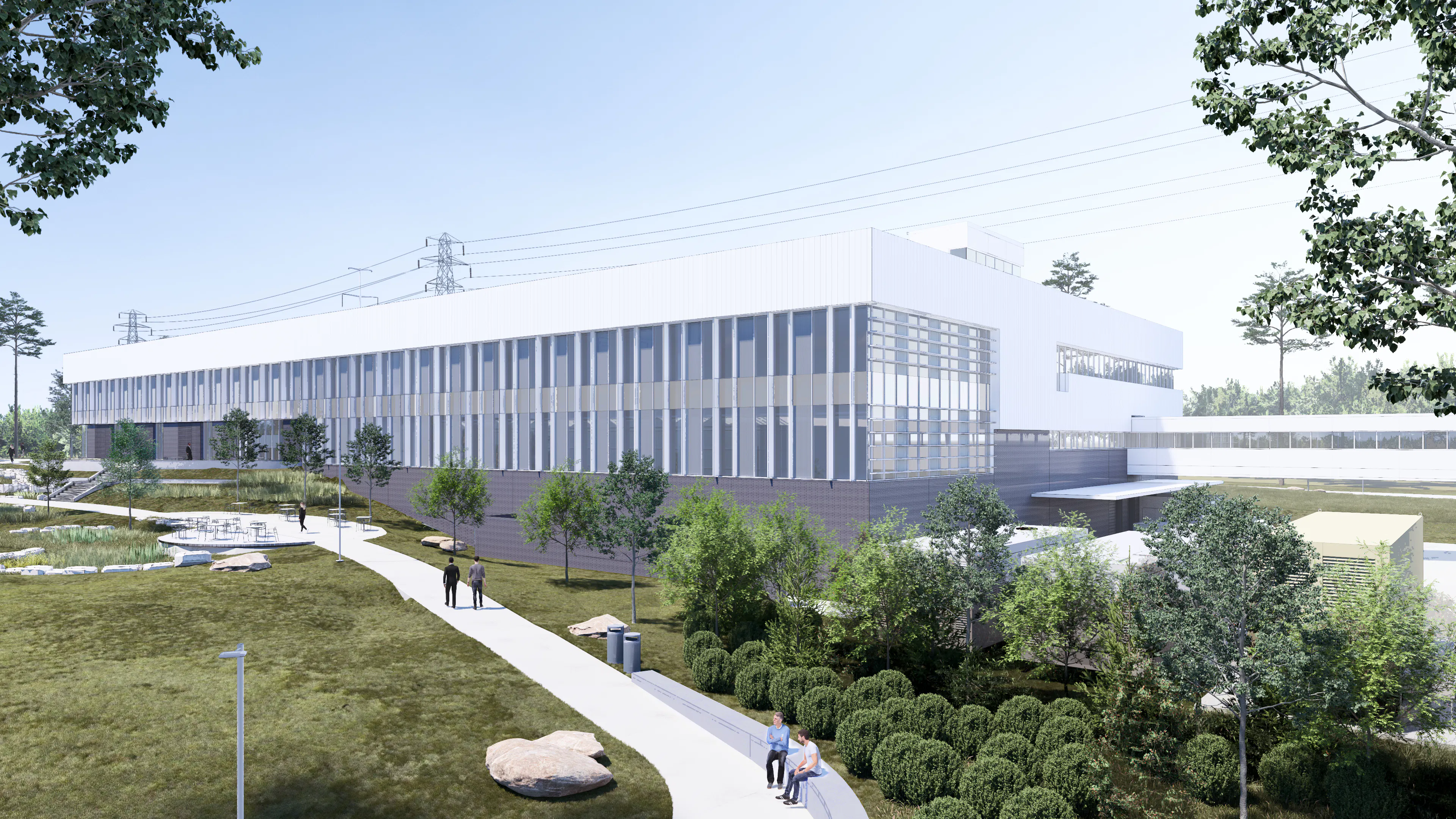
The growing range of expertise is evident in the projects that followed. At United Therapeutics' Project Lightyear in Research Triangle Park, Hanbury designed a 51,000-square-foot pharmaceutical logistics facility with a goal of site net-zero energy and carbon performance. Nearly 1,200 rooftop solar panels and an integrated battery system support its energy strategy. The building sits adjacent to an existing fieldhouse designed by North Carolina architect Frank Harmon.
In Morrisville, Hanbury's relationship with Trinity Capital Advisors grew from the adaptive reuse of Park Point into the planning and design of sPARK Life Science Campus, a 102-acre development for scientific research and advanced manufacturing. The campus brings laboratories and production facilities together around shared amenities and outdoor spaces, giving a large-scale science development the qualities of a connected workplace.

Raleigh's growing science expertise has also found applications in Hanbury's longstanding work with research universities. At NC State University, the renovation of Polk Hall brings higher education and laboratory planning experience together, modernizing a 119,000-square-foot academic building for contemporary teaching and research.
At UNC Charlotte, the challenge was considerably smaller in scale. A student-led initiative resulted in a 132-square-foot space for wellness and ritual washing within the Cone Student Center. Working with university stakeholders, Hanbury developed an accessible setting for religious practices that had not been adequately accommodated on campus.


The exchange between education and practice extends to Hanbury's investment in emerging talent. Internships and the Summer Scholars program provide emerging designers with opportunities to pursue research grounded in local communities. In Raleigh, the 2021 Summer Scholars partnered with the Raleigh Alumni Chapter of Kappa Alpha Psi to envision Kappa Achievement Park, drawing on conversations with residents to shape their proposals. Murphy sees that same exchange of knowledge within the studio, where younger colleagues bring new perspectives to experienced professionals. “We're kind of a sponge for each other.”


The growth has exceeded even the early team's expectations. When Small joined in 2019, business planning suggested Raleigh might eventually reach 25 people. Even 40 seemed ambitious. The practice has since surpassed those estimates, outgrowing successive workplaces as its projects and expertise expanded.
James Benson joined Raleigh in 2019 as the team's seventh employee, taking what he describes as “a leap of faith.” Now Hanbury's Raleigh Office Leader and Chief Financial Officer, he measures the practice's growth by more than its size.
“One of the most rewarding parts of this journey has been watching our people grow, develop their strengths, take on leadership roles, and achieve incredible things.”
As the team expanded, Benson wondered whether it could retain the closeness of its early years. “We wanted to make sure that as we grew, we didn't lose the culture and the feel that was so important to everybody,” he recalled. Looking back, he believes it has. “We've grown, but we don't feel bigger.”

In 2026, AIA North Carolina named Hanbury its Firm of the Year, recognizing the quality of its architecture and its contributions to the profession. For Small, the recognition is just part of a much longer story.
“I think it's recognition of where we're going, not where we've been,” he said. “It's just a stepping stone to what's next for the entire firm.”